Best AI Website Builders Compared for Entrepreneurs
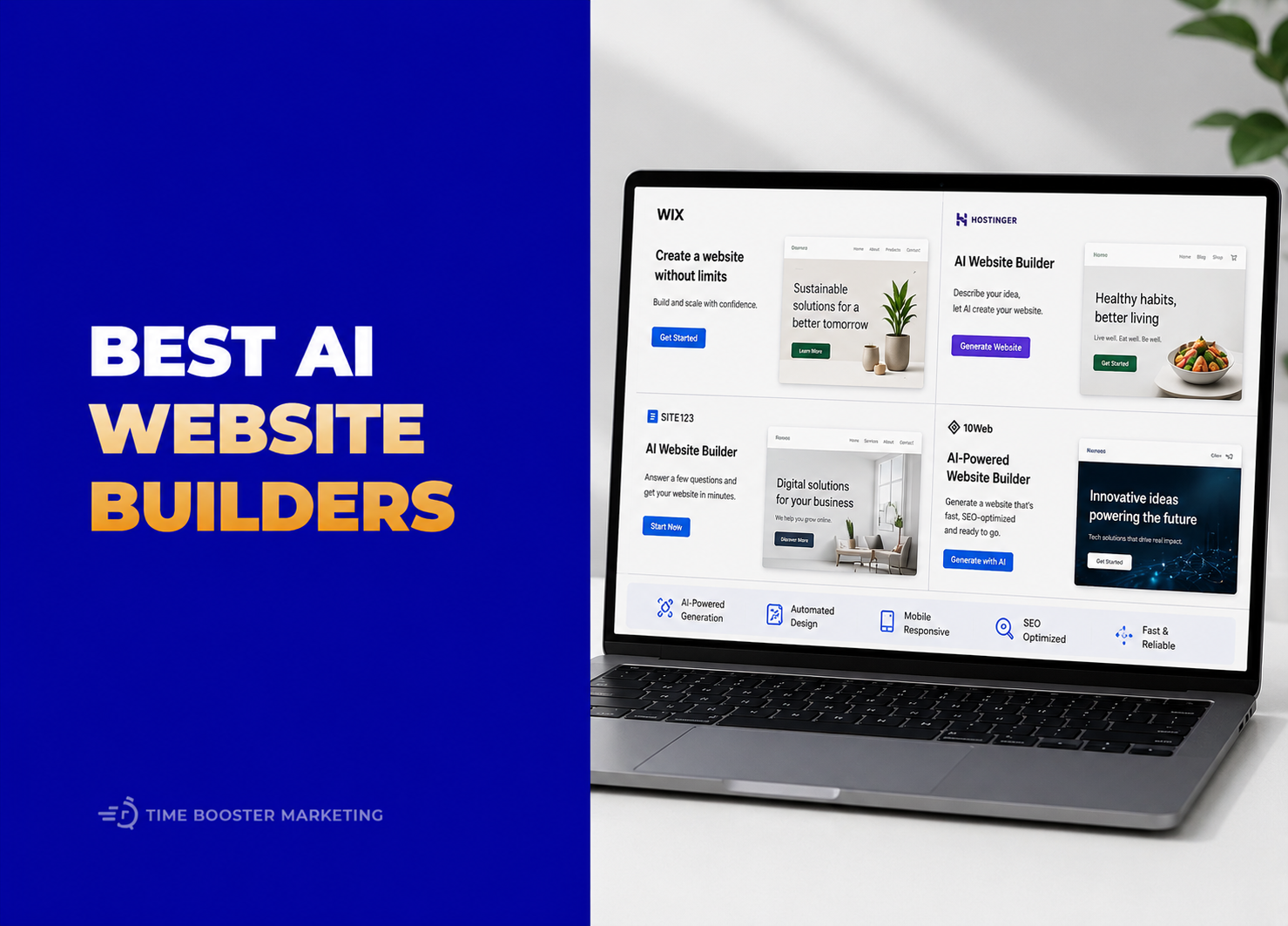
AI website builders can help entrepreneurs launch faster, but not every tool fits every business. Some are best for simple service websites, others for e-commerce, design control, WordPress flexibility, or agency workflows.
Originally published by Time Booster Marketing
Best AI Website Builders Compared for Entrepreneurs
AI website builders have made it easier for entrepreneurs to launch a website quickly.

You can describe your business, choose a style, generate pages, create copy, add images, and publish a basic site faster than traditional manual design. But speed is not the same as strategy.
A website that launches in minutes can still fail if the message is vague, the layout is confusing, the mobile experience is weak, the SEO structure is thin, or customers cannot easily contact, book, buy, or trust the business.
The best AI website builder is not the one with the most exciting demo. It is the one that matches your business model.
What AI Website Builders Actually Do
AI website builders usually help with five things: page structure, design layout, website copy, images, and editing suggestions.
For example, Wix AI Website Builder lets users describe their vision through a conversational interface, then generates a complete site with industry-specific logic, tailored copy, and visuals. Wix also allows manual editing after AI generation, which matters because entrepreneurs still need to refine the website around real offers, pricing, trust signals, and customer behavior.
The practical lesson is simple: AI gives you a first draft. You still need business judgment.
1. Wix AI Website Builder: Best Overall for Small Businesses

Wix is one of the strongest all-round AI website builders for entrepreneurs who want a balance of speed, design control, marketing tools, e-commerce options, booking features, and beginner usability.
Use Wix if you need:
- a service business website
- booking or appointment features
- small e-commerce
- marketing tools
- flexible design editing
- a fast professional launch
Wix’s pricing page shows plans ranging from a free plan to paid tiers with features such as hosting, drag-and-drop editing, storage, marketing suites, e-commerce, scheduling, collaborators, and custom domain support depending on plan. Prices vary by location and billing terms, so entrepreneurs should always confirm final checkout pricing before subscribing.
Wix is best for founders who want a polished website without managing hosting or plugins.
The limitation is platform lock-in. If you later need deep custom development or full server-level control, Wix may feel restrictive.
2. Hostinger AI Website Builder: Best Budget-Friendly Starter Option
Hostinger AI Website Builder is a strong option for entrepreneurs who want a low-cost, beginner-friendly way to generate and edit a professional website.
Hostinger describes its AI website builder as a tool that can generate a custom website from a prompt, with no coding or technical knowledge required. It also combines AI generation with drag-and-drop editing, which is useful for entrepreneurs who need speed but still want to adjust pages visually.
Use Hostinger if you need:
- a simple company website
- a landing page
- a portfolio
- a small business site
- basic SEO pages
- affordable hosting and website building in one place
For African entrepreneurs watching cash flow closely, Hostinger can be attractive because it reduces setup complexity and keeps entry costs lower than many premium builders.
The limitation is that very complex businesses may eventually outgrow a basic builder-style setup.
3. Squarespace Blueprint AI: Best for Elegant Brand Presentation
Squarespace Blueprint AI is best for entrepreneurs who care heavily about clean design, brand presentation, photography, portfolios, coaching, consulting, wellness, food, design, hospitality, and creative services.
Squarespace says its Blueprint AI Builder generates a personalized website framework using business details, images, copy, and design suggestions, while still allowing users to edit text, images, layouts, and site styles after generation. Squarespace also says Blueprint AI websites are responsive and include SEO-friendly structure and tools such as editable meta descriptions and custom URLs.
Use Squarespace if your brand needs to look premium from day one.
The limitation is that it may be less flexible than WordPress or Webflow for advanced custom logic, complex integrations, or highly technical workflows.
4. Webflow AI: Best for Design Control and Scaling Brands

Webflow AI Site Builder is best for entrepreneurs, agencies, startups, and design-conscious brands that want more control than a simple drag-and-drop builder.
Webflow says its AI site builder can turn an idea into a designed, functional website in minutes, and users can continue using Webflow AI to edit, optimize, and scale the site as the business grows.
Use Webflow if you need:
- stronger visual control
- advanced landing pages
- SaaS-style websites
- startup websites
- agency-grade design
- CMS-driven content
- better design scalability
The limitation is learning curve. Webflow is powerful, but beginners may need more time or professional support to use it well.
5. Shopify: Best for Entrepreneurs Selling Products Online
Shopify is not just an AI website builder. It is a commerce platform.
That makes it the better choice if your main goal is selling products online, managing inventory, accepting payments, tracking orders, and scaling e-commerce.
Shopify’s pricing page explains that Shopify includes secure commerce hosting, unlimited bandwidth, SSL certificates, and domain support with its plans. It also notes that Shopify is available in nearly every country, but some features vary by country, including Shopify Payments availability. This matters for African entrepreneurs because payment options and checkout workflows may differ depending on location.
Shopify’s AI assistant, Sidekick, is built around commerce workflows and can work with Shopify data, permissions, customers, companies, payments data, and store operations.
Use Shopify if the website is primarily an online store.
Do not choose Shopify for a simple brochure website unless commerce is central to the business.
6. WordPress.com AI Website Builder: Best for Content and Long-Term Publishing

WordPress.com AI Website Builder is best for entrepreneurs who want AI speed with WordPress-style content flexibility.
WordPress.com says its AI website builder can create a fully designed website in minutes and is available on all paid plans. The setup asks users to describe the website, then generates layout, suggested images, content, and pre-filled sections based on the industry or goal.
Use WordPress.com if you need:
- blogging
- SEO content
- resource pages
- business articles
- long-term publishing
- flexible site growth
- a familiar content-management system
The limitation is that full WordPress flexibility depends on the plan and setup. Entrepreneurs should compare WordPress.com carefully with self-hosted WordPress before committing.
7. 10Web: Best for AI-Powered WordPress and Agencies
10Web is useful for entrepreneurs and agencies that want AI website generation on top of WordPress infrastructure.
10Web’s pricing page lists AI website generation, WordPress CMS access, hosting, mobile optimization, AI credits, team management, migrations, WooCommerce support, white-label options, and agency features depending on plan. It also positions itself around AI-powered WordPress site creation, redesigning, cloning, Figma-to-site workflows, and managed hosting.
Use 10Web if you want:
- WordPress flexibility
- AI generation
- WooCommerce support
- agency workflows
- multiple client websites
- white-label options
The limitation is that it may be more platform-heavy than a solo entrepreneur needs for one simple website.
8. Dorik: Best for Simple Sites, Agencies and White Label Work

Dorik is a practical AI builder for entrepreneurs, freelancers, and small agencies that need fast websites, custom domains, blog pages, collaborators, white-label options, and code export depending on plan.
Dorik’s pricing page lists AI website generation across plans, with features such as custom domains, pages, blog posts, storage, bandwidth, collaborators, white-label dashboard, code export, and client billing depending on the tier.
Use Dorik if you need:
- simple websites
- agency-friendly pricing
- white-label dashboards
- fast client delivery
- landing pages
- lightweight business sites
The limitation is that advanced businesses may prefer Shopify, Webflow, or WordPress-based systems depending on integrations and scale.
9. GoDaddy Airo for WordPress: Useful, but Check Product Direction
GoDaddy has been actively moving its AI website experience toward Airo and WordPress.
GoDaddy’s help documentation notes that the older GoDaddy AI Website Builder was being discontinued on July 31, 2026, with customers moved to the classic Websites + Marketing builder, while Airo AI Builder remains an option for generating content, images, logos, tracking insights, web apps, online stores, and custom tools.
GoDaddy also launched Airo for WordPress, describing it as an AI-powered experience for creating, editing, managing, and growing WordPress websites, including WooCommerce storefront generation and access to WordPress plugins.
Use GoDaddy Airo for WordPress if you want GoDaddy’s domain, hosting, support, and WordPress AI workflow together.
The caution is product transition. Entrepreneurs should verify exactly which GoDaddy builder they are buying before committing.
Quick Comparison: Which AI Website Builder Should You Choose?
Choose Wix if you want the best all-round business website builder.
Choose Hostinger if budget and beginner simplicity matter most.
Choose Squarespace if brand design and visual polish matter most.
Choose Webflow if you want advanced design control and scalability.
Choose Shopify if your main goal is e-commerce.
Choose WordPress.com if content, blogging, and publishing matter.
Choose 10Web if you want AI-powered WordPress with agency or WooCommerce potential.
Choose Dorik if you need simple sites, agency workflows, and white-label flexibility.
Choose GoDaddy Airo for WordPress if you want GoDaddy infrastructure with WordPress-based AI support, but confirm current product status first.
Decision Framework for Entrepreneurs
Before choosing, answer six questions.
1. Are You Selling Products or Services?
If products are central, Shopify should be on your shortlist. If you sell services, Wix, Hostinger, Squarespace, Webflow, or WordPress may fit better.
2. Do You Need Speed or Control?
Hostinger and Wix are stronger for quick launch. Webflow and WordPress-based tools are stronger for deeper control.
3. Will SEO Content Matter?
If you plan to publish many articles, guides, or resources, WordPress.com, 10Web, Webflow, or Wix may serve you better than a purely simple landing-page builder.
4. Do You Need Payments?
Check payment availability in your country before choosing. This is especially important for African entrepreneurs because payment features often vary by market.
5. Can You Edit the Site Yourself?
The best AI builder is useless if you cannot update prices, pages, photos, testimonials, offers, and contact details without waiting for someone else.
6. What Happens When the Business Grows?
Do not choose only for launch day. Choose for the next 12 to 24 months.
AI Can Build the Website Draft. Strategy Builds the Business.
AI website builders are useful because they reduce the time, cost, and fear of launching online.
But they do not replace positioning, offer clarity, SEO, trust-building, conversion copy, customer research, local payment reality, WhatsApp integration, analytics, or consistent content.
For most entrepreneurs, the smartest path is to use AI to launch faster, then improve the site with real business insight. Add stronger service pages. Rewrite generic copy. Include testimonials. Connect Google Analytics and Search Console. Add WhatsApp or booking links. Improve page titles. Show proof. Answer customer questions.
AI can help you start. Your strategy determines whether the website produces leads, sales, bookings, or trust.